Department Stores: A Decaying Model or a New Platform?
A strategic business analysis of department stores
Why I am writing this piece
At the time of writing, I am working in a traditional retail company in Singapore as an IT staff member. My observations of day-to-day store operations and the broader rhythm of physical retail have led me to question whether department stores are still operating on a model that assumes a centralised customer journey.
This piece begins from that observation, but does not treat it as evidence in itself. Instead, it explores that question using publicly available evidence, existing research and comparative cases.
This is an independent personal analysis based on publicly available information. It does not represent the views of my employer.
Introduction
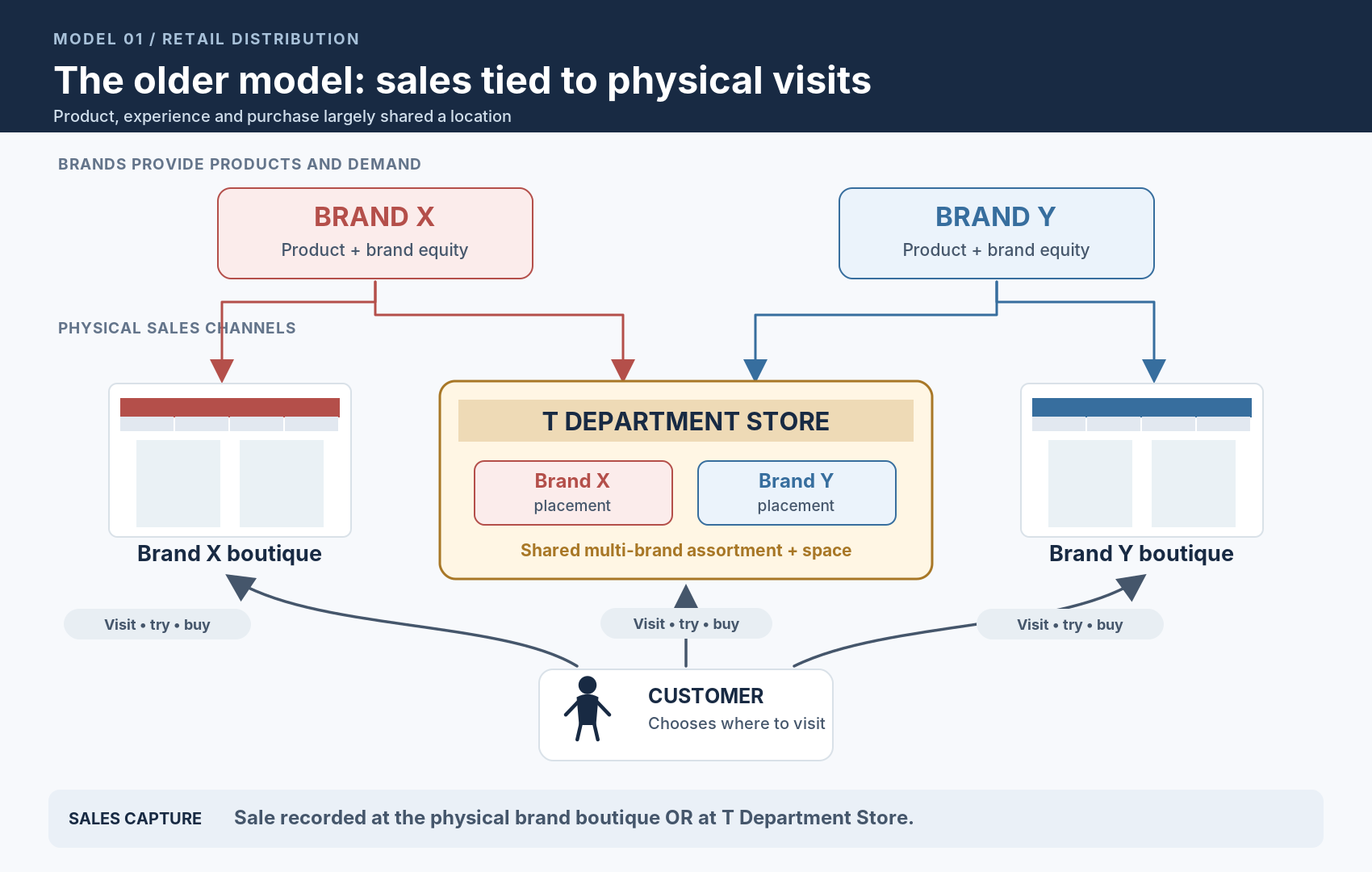
Traditional department stores were optimised for the discovery, comparison and purchase stages of the customer journey. Exploration, experience, validation and social proof were implicit in the old model, as you could walk around the department store, touch and feel products, and get your companions' feedback before making a purchase decision. The value proposition of department stores was a one-stop location for all steps in the customer's journey where customers could discover and explore new brands or products, compare products and brands and make a purchase decision. The second-order value proposition was for brands: department stores provided another channel to move goods through wholesale. Operationally, department store businesses rented spaces, purchased stock from partner brands and sold them at a profit. They optimised for price, convenience and availability to generate sales.
The Good Ol' Days
Back in those days, department stores were the rage. Fashion, accessories, furniture and food were all in one convenient location. They were places to be, places to spend time in and, if you wanted something, they were the places to buy it.
The model worked because the interests of the department store, the brands and the consumers were broadly aligned. The stores aggregated the products and people. The brands gained access to customers. Customers gained convenience, discovery, comparison, and trust. The department store sat at the centre of that exchange and captured value through transactions.
The Changed Environment
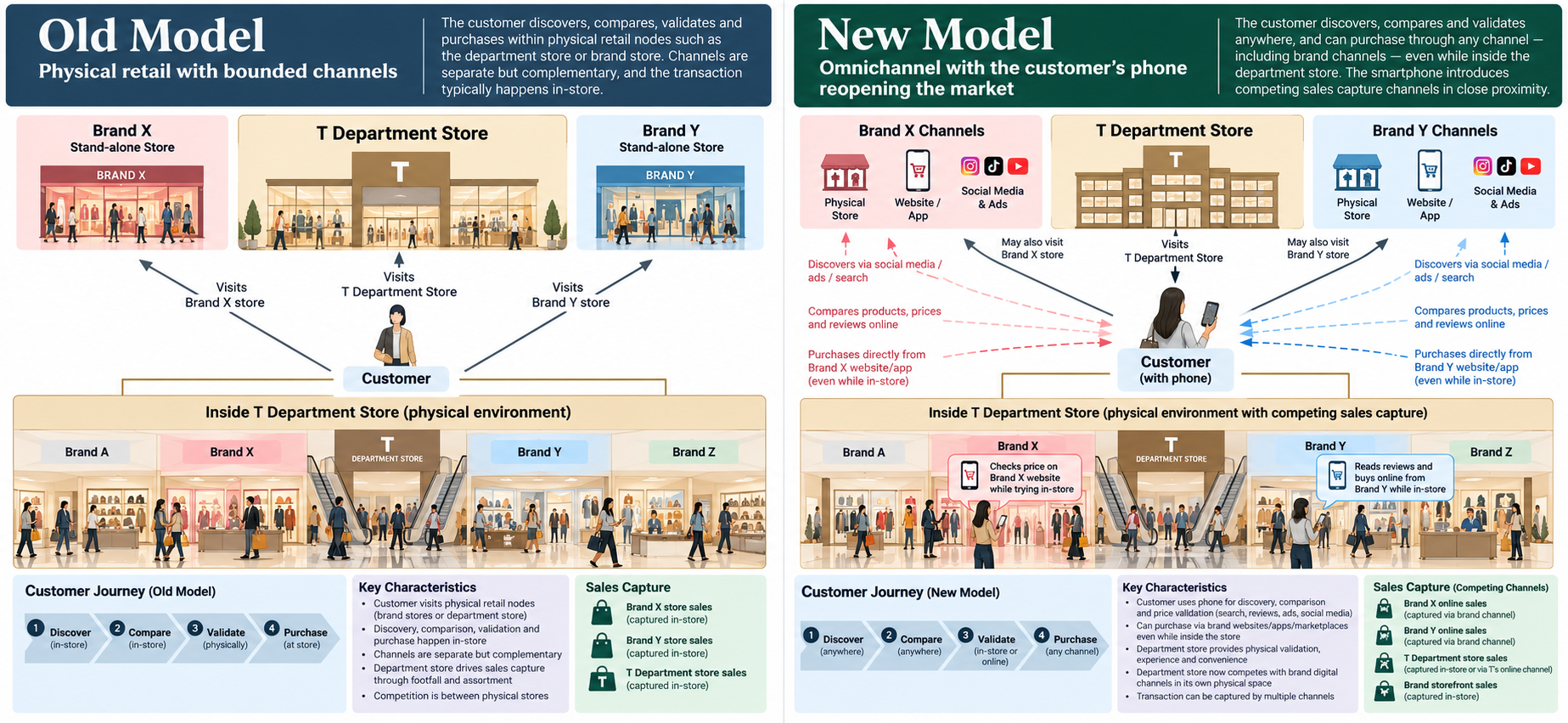
The advent of digital technology has led to increased access to information across different areas, which has decentralised the customer journey. The customer journey still involves discovery, exploration, experience, comparison, validation, community or social confirmation, and purchase. However, purchases may no longer happen in-store.
Now imagine a traditional department store in the current market. It rents space, holds inventory and receives customer footfall but doesn't see equivalent sales conversions. It has the goods and the space, and more people are coming in, so why is revenue not increasing?
The Customer Now Knows Better: Information Access in the Customer Journey
In the current environment, potential customers can discover brands on their phones. Equally, brands can discover potential customers. Digital channels have transformed discovery from something primarily initiated by the customer into a continuous interaction between consumer intent and algorithmic targeting.
Customers may actively discover products through search engines, social media, marketplaces and AI assistants. At the same time, brands attempt to place themselves in front of relevant customers through targeted advertising, search engine optimisation (SEO), generative engine optimisation (GEO), recommender systems and social-media algorithms.
Discovery therefore no longer requires the customer to enter a department store. A customer who has never heard of Brand X may encounter it while scrolling through Instagram, receive a recommendation from an algorithm, see it mentioned by a creator, find it through a search query, or encounter it in an AI-generated response.
Validation and comparison can now also be done easily on a mobile phone. Customers on e-commerce platforms and search aggregators can look at reviews of products and places before deciding to visit or buy a product. With augmented reality technology, customers can "try on" clothes and accessories on their mobile phones. Think of Lenskart, which allows customers to preview how glasses would fit them.
Where a customer might once have gone shopping with friends and asked, “Does this look good on me?”, that same confirmation can now be sought through messaging groups, social networks, online communities, creators and enthusiast forums. The relevant social group no longer needs to be physically present.
Finally, the transaction itself has become increasingly portable. Once the customer has discovered, compared and validated a product, online storefronts, digital payments and delivery services allow the purchase to be completed immediately through whichever channel offers the most attractive combination of price, convenience, trust and service.
Discovery, comparison, validation and social confirmation already existed within traditional retail. What digital technology has done is decompress them and make them more accessible to customers. Activities that were once bundled within a physical shopping trip can now occur independently, across different channels, at different times and through different commercial actors.
The department store has consequently lost part of one of its historical functions: being the environment in which much of the customer's purchase decision was formed and contained.
The Role of Physical Retail Is Smaller but Still Important
Physical retail, however, still retains an important role in completing product validation. Digital channels can reproduce part of the validation process through reviews, specifications, images, video and augmented-reality tools. However, this validation remains incomplete. A screen cannot fully reproduce tactile qualities such as texture and weight, olfactory qualities such as scent, gustatory qualities such as taste, or the embodied experience of physically wearing and interacting with a product.
The sucker that never changed
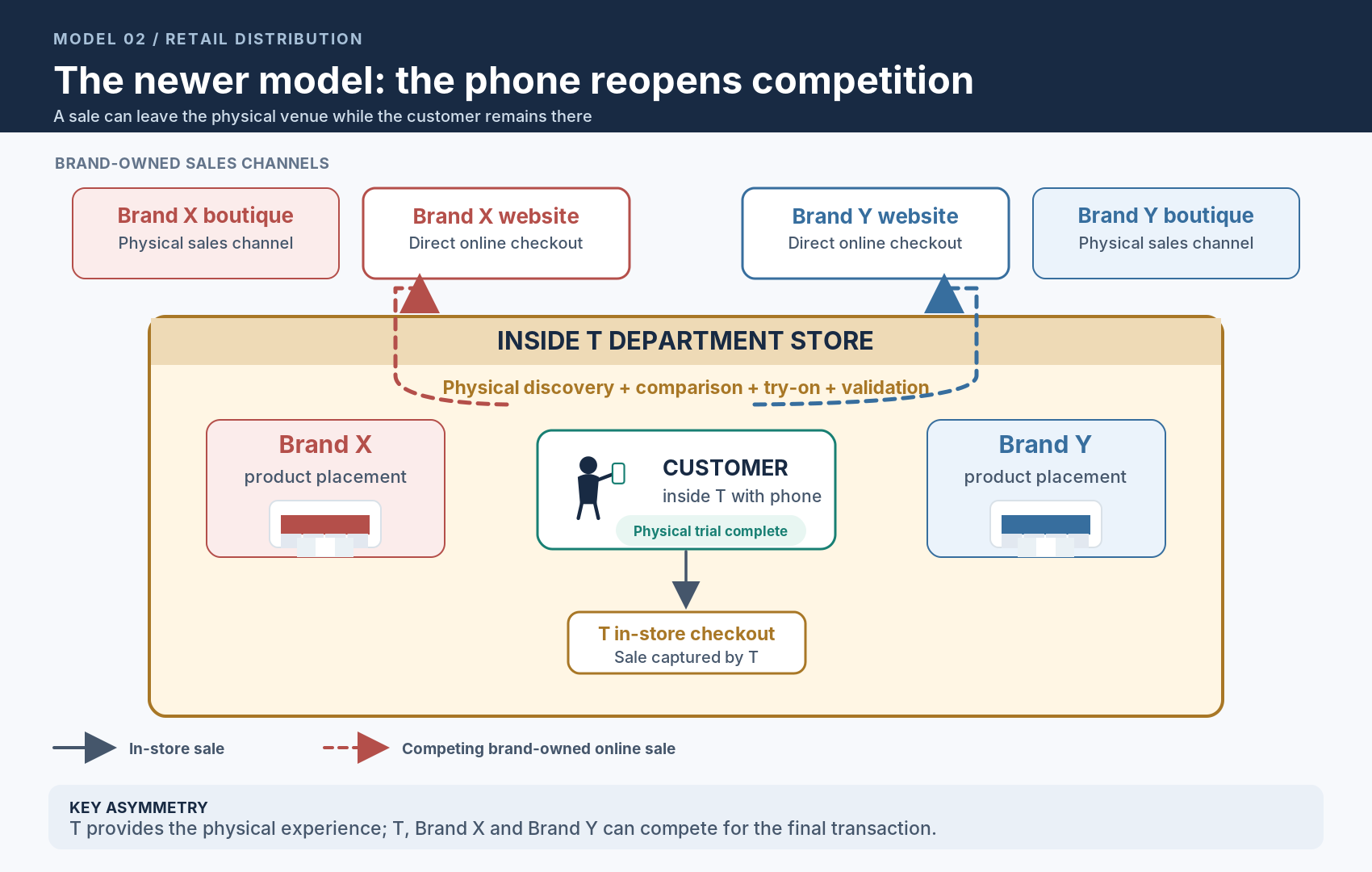
Now, in the present, you are overwhelmed with life and need a little retail therapy. You think of T Dept Store. It’s nice to walk around a department store to see what’s available: maybe a nice shirt from Brand X, a dress from Brand Y, or a speaker from Brand A. You touch and feel the shirt and dress, try them on and compare them. Maybe you discover something new that you didn’t think you needed.
Then you decide: "Damn, I look good in this shirt."
The shirt is priced in-store at $90.00. Then you check your phone: it is $79.99 on Brand X's website. A search brings you to a forum with a discount code. The shirt is now $70.00 with free shipping.
In that arc of a story, we can see that T Dept Store created the physical environment in which the customer discovered the shirt, touched it, tried it on and compared it with alternatives and, most importantly, decided that they wanted it. But it did not convert into a sale in T Dept Store.
T Dept Store may run a consignment model to reduce its liability. However, even then, if inventory does not move, no revenue is generated, and merchandise still occupies valuable but limited floor space.
Brand X, meanwhile, captures revenue through its e-commerce channel.
Brand X's investment works across several layers simultaneously: its advertising campaign created awareness, its e-commerce platform readily captured the transaction and its product placement in T Dept Store provided a physical environment for discovery, trial and validation. Brand X may also have benefited from association with T Dept Store's brand capital, location, service environment and customer base.
The result is an asymmetry in value creation and capture.
T Dept Store may contribute meaningfully to the customer's decision to purchase without being the party that ultimately records the sale.
Brand X, by contrast, is able to combine the department store's physical presence with its own digital channel and capture revenue whenever the customer chooses to transact.
Why Adopting an E-Commerce Strategy Is Insufficient
A possible response to the decompression of the customer journey is obvious: follow the customer online.
Department stores can invest in omni-channel retail, improve their digital user experience, optimise for search engines and generative engines, build mobile applications, integrate inventory across online and physical stores, and compete through digital advertising and personalised marketing. These capabilities are necessary. But they are not necessarily sufficient. The structural problem remains that a department store is largely selling products whose underlying demand belongs to somebody else.
If a customer wants a shirt from Brand X, both Brand X and the department store can now compete digitally for the same transaction. The department store may offer a better website, faster delivery, loyalty points or superior service, but Brand X still owns the product, the brand identity and increasingly its own direct relationship with the customer. The relationship therefore becomes one of coopetition (cooperation and competition).
Brand X needs the department store for physical exposure, access to customers and incremental distribution. At the same time, Brand X's own digital channel competes directly with the department store for transaction capture. Simply becoming better at e-commerce therefore risks moving the same competition from the shop floor onto a screen.
From a Shopping Mall in a Shopping Mall to an "Experience Platform"
Changes in Consumer Behaviour and Profiles
Hypothesis: An increasingly heterogeneous consumer base is emerging whose exposure to products, brands and aesthetics is shaped by their personalised digital environments.
Popular entertainment, search engines, social-media feeds, recommender systems, online communities and AI assistants can expose different consumers to increasingly different combinations of products, styles, subcultures and brands. Rather than encountering broadly similar selections through the same mass-market channels, consumers may develop more individualised tastes and purchasing preferences.
This may contribute to a segment of consumers who are less brand-loyal, more driven by aesthetics and identity, and more receptive to niche and unfamiliar brands. They are also more interested in novelty and product stories, and are more price-aware because comparisons are readily available.
The result may be less a transition from one dominant consumer profile to another and more a fragmentation into a greater variety of consumer identities, tastes and purchasing behaviours.
Utilising Space to Create Experiences and Stories
A department store can utilise space dynamically rather than treating every square metre as a static brand allocation. It can use such spaces for:
- Fashion shows
- Craft experiences
- Thematic installations
- Seasonal arrangements
- Cultural or lifestyle themes
- Temporary niche-brand showcases
To some extent, department stores such as Takashimaya Singapore already do this. Spaces such as Takashimaya Square and Talking Hall are used for temporary events, cultural showcases, promotional campaigns and rotating product themes.[1]
The question is therefore not whether the department store is capable of creating experiences. It is whether these experiences remain adjacent to the traditional retail model, or whether the principles behind them can become more deeply integrated into how the department store allocates space, curates products and organises the customer experience.
A temporary event space can attract visitors for a few weeks. A more fundamental shift would mean applying the same flexibility across the broader store: reorganising products around themes, occasions, aesthetics and customer interests rather than treating brand and category boundaries as fixed.
The central principle becomes: Do not organise only around what the organisation sells. Organise around what the customer is trying to experience, achieve or express.
The distinction is therefore between running events within a department store and operating the department store itself as a programmable experience platform.
From Brand Silos to Cross-Brand Curation
Highlighting Smaller Brands
One opportunity for department stores is to use complementary pieces to create win-win-win outcomes between the department store, established brands and smaller brands. A customer may enter the store looking for a known brand, but the department store can use that anchor product as a starting point for broader cross-brand discovery.
For example, a customer trying on a shirt from an established Brand X could be shown trousers from a smaller Brand Y, shoes from Brand Z and accessories from an emerging local designer. The pieces are not necessarily competing with one another. They are complementary components of the same customer outcome: completing an outfit. This creates three potential winners.
The customer receives a more complete and contextualised shopping experience. Instead of evaluating isolated products, they can see how different pieces work together physically. The smaller brand gains exposure to customers it may struggle to acquire independently. It benefits from association with established brands and from being placed within a relevant purchasing context rather than relying solely on its own marketing reach. The department store creates value that neither individual brand can easily reproduce on its own: cross-brand curation, physical validation and coordinated discovery within a shared environment.
The department store therefore does not merely aggregate brands. It can actively construct relationships between them. A smaller brand no longer needs to attract the customer entirely by itself. It can be introduced as a complementary solution to demand that already exists elsewhere in the store. The department store’s advantage then lies not simply in carrying more brands, but in deciding how those brands can create value together.
Collaboration and Its Limits
Cross-brand collaboration, however, is not automatically positive-sum. Luxury branding in particular often depends on exclusivity, controlled presentation and carefully managed comparison. A luxury brand may want to control how its products are displayed, which products appear beside them, how prices are communicated and the broader environment in which the customer encounters the brand. Excessive cross-brand mixing can therefore weaken some of the very mechanisms through which luxury brands create value.
A luxury product displayed too directly beside competing products may encourage price or feature comparison when the brand would prefer the customer to experience a distinct brand world. Shared displays may also dilute visual identity, storytelling and perceptions of exclusivity. The interests of the department store and the individual brand may therefore diverge. The department store benefits from encouraging customers to compare, combine and discover across brands. The luxury brand may benefit from limiting that comparison and keeping the customer within its own controlled environment.
Striking a Balance
The objective should therefore not be to eliminate brand boundaries. Instead, the department store can distinguish between situations where cross-brand curation creates complementary value and situations where separation remains strategically important.
Direct competitors may remain relatively distinct, particularly where brand identity and exclusivity form a substantial part of the product’s value proposition. Complementary categories, however, can be connected more freely.
A luxury watch does not necessarily compete directly with a niche leather accessory. A designer shirt may complement footwear, fragrance or accessories from another brand. A craft product can add narrative depth to a broader thematic arrangement without requiring the participating brands to appear as formal collaborators. This suggests a model based less on forced brand collaboration and more on curated adjacency.
The department store determines where products and brands can reinforce one another while preserving the degree of separation required for individual brand identities. The strategic capability is therefore not simply collaboration. It is knowing when to combine, when to separate, and how to construct relationships between brands without erasing what makes each of them valuable.
Over time, the department store may also serve as a gateway through which brands encounter and build relationships with one another.
Temporary thematic arrangements, shared events and complementary product placements allow brands to observe how their products, audiences and identities interact without requiring an immediate formal partnership. Successful combinations could subsequently develop into deeper collaborations, joint campaigns or new product concepts.
The department store therefore becomes not only a curator of relationships between products and customers, but potentially an intermediary through which relationships between brands themselves can emerge.
Case Studies
Decathlon: Designing Space Around What the Customer Is Trying to Achieve
Decathlon is not a department store, but it provides a useful adjacent comparison because its retail environment is organised substantially around customer activities rather than independent brand identities.[3]
Its larger Experience Stores are organised around sporting activities rather than independent brand identities. In Singapore, these stores provide access to thousands of products across approximately 60 sports, alongside pre-purchase product testing, sports events and product personalisation.
The organising principle is therefore less:
Brand → Product → Customer
and closer to:
Customer objective → Relevant products → Trial → Advice → Purchase → Use → Support
A customer may enter because they want to begin running, prepare for a camping trip, cycle to work or play badminton. Different product categories are meaningful because they contribute to the same activity or outcome.
This closely reflects the earlier principle: Do not organise only around what the organisation sells. Organise around what the customer is trying to achieve.
More importantly, this customer-centred logic continues beyond the layout of the store.
Decathlon Singapore provides repair and maintenance services for products such as bicycles and rackets, including servicing, reconditioning and restringing.[5] It also operates a Buy Back programme through which eligible used products can be inspected, refurbished and subsequently sold through its Second Life programme. The programme covers categories ranging from bicycles and fitness equipment to camping products and rackets.[4]
Like Selfridges, the customer relationship can therefore extend beyond the original sale:
Discover → Test → Purchase → Use → Maintain → Repair → Trade in → Refurbish → Resell → Purchase again
Convenience is similarly designed across channels. Customers can purchase products digitally and collect eligible orders from stores within two hours, while home delivery options allow the physical and digital store to function as parts of the same fulfilment system.
The store is therefore not simply a location containing sports products. It forms one component of a broader system supporting the customer's participation in sport:
Advice + Products + Physical trial + Fulfilment + Maintenance + Repair + Resale + Activities
This makes Decathlon particularly relevant to the department-store thought experiment. It demonstrates what can happen when customer-centred design is applied not merely to the interface or shop floor, but to the wider business logic surrounding the product.
However, Decathlon also benefits from an important structural advantage. Much of its product ecosystem is controlled within the wider Decathlon organisation. It can therefore coordinate products, services, space and customer journeys with substantially less negotiation between economically independent brands.
A department store faces a harder institutional problem. To produce a comparable customer-centred experience, it may need to coordinate:
Customer objective → Brand A + Brand B + Brand C + Staff + Service + Space
Those brands still retain separate commercial incentives, identities, merchandising requirements and customer relationships.
Decathlon therefore does not provide a template that department stores can simply reproduce. It provides something more useful: an example of what customer-centred retail looks like when the surrounding operating model, services and information flows are also designed around the customer's objective rather than only around the initial transaction.
Sephora: Cross-Brand Curation in a Coherent Category
Sephora operates within a relatively coherent category: beauty. This considerably reduces the complexity of cross-brand curation. Cosmetics, skincare, fragrance and related services are sufficiently different to provide variety while remaining closely connected to a common set of customer needs.
Its operating model nevertheless demonstrates many of the mechanisms proposed earlier.
Sephora does not merely provide shelf space to beauty brands. Its Beauty Advisors actively provide product knowledge and assist customers with discovery, while stores provide makeup and other beauty services. Sephora describes its Beauty Advisors as responsible for building customer relationships through beauty knowledge and helping customers discover products across its beauty selection. In-store services are similarly delivered by trained Beauty Advisors rather than relying solely on individual brand representatives.[6] This changes the role of the retailer.
A customer can enter Sephora with a problem: "I need a foundation that works for my skin." The retailer can then help the customer navigate several possible solutions. The unit of organisation therefore shifts:
Customer need → Comparison & experimentation → Advice → Product selection
This is close to the user-centred principle underlying the proposed department-store model.
Sephora also benefits from physical validation. Beauty is particularly suited to experiential retail because customers may want to test colour, texture, scent and compatibility before purchasing. The physical store therefore performs a function that online product listings cannot completely reproduce.
At the same time, Sephora's multi-brand environment creates opportunities for discovery. A customer attracted by one established brand can encounter competing or complementary products from others while remaining within the retailer's environment.
This is important for the earlier argument around smaller brands.
Instead of every brand independently acquiring the customer, the retailer can create an audience and then expose that audience to a curated assortment of products. The value of the retailer lies partly in deciding what deserves to be placed in front of the customer.
The result is a stronger retailer-level proposition.
A customer can think: "I need a beauty product, so I will go to Sephora" rather than "I need Brand X, and Sephora happens to sell it." That distinction matters because it gives the retailer some ownership over discovery and customer relationships rather than leaving demand entirely with the brands it carries.
Galeries Lafayette: Collaboration and Experience Monetisation
Galeries Lafayette provides a useful example of a department store moving beyond simple aggregation towards active orchestration of brands, cultural content and customer experiences.
Its Paris Haussmann flagship runs fashion shows, cooking classes, macaron workshops and heritage tours as bookable experiences. The fashion show, for example, is directly ticketed, meaning that the experience itself becomes a source of revenue rather than functioning purely as a mechanism to increase footfall.[7]
This creates a different commercial logic. The department store is not only attempting to convert visitors into merchandise transactions. It can also monetise the visit itself.
Galeries Lafayette also provides examples of explicit collaboration between brands and cultural partners. In 2026, its Céline Dion pop-up was developed with Universal Music France's A&R Studios and featured products created with partners including Maje and Pierre Hermé. Fashion, music and food were therefore combined around a common cultural narrative rather than operating as unrelated categories within the same building.[8]
The structure becomes:
Theme or audience → Department-store curation → Multiple brands and partners → Shared experience → Commerce
This is close to the proposed role of the department store as an intermediary between brands.
The department store contributes value by selecting the participants, constructing the theme and providing the physical context in which those relationships become meaningful to the customer.
However, the public-facing evidence does not show whether such collaborations form a systematic operating model or remain primarily temporary campaigns and activations.
It is therefore difficult to determine whether Galeries Lafayette systematically investigates the following questions:
- Which brands benefit from one another?
- Does cross-brand exposure produce incremental sales?
- How should value be attributed between participating partners?
- Do successful temporary collaborations develop into longer-term commercial relationships?
Galeries Lafayette nevertheless demonstrates two important points. First, explicit cross-brand and cross-industry collaboration within a department store is possible. Second, experiential retail does not necessarily have to be monetised indirectly through hoped-for increases in merchandise sales. Some experiences can themselves become products.
Selfridges: Extending Value Beyond the Initial Transaction
Selfridges provides a different response to the changing role of physical retail. Rather than concentrating exclusively on acquiring customers and selling new merchandise, its Reselfridges programme attempts to extend the retailer's relationship with customers across a larger portion of the product lifecycle. Reselfridges incorporates pre-owned merchandise, resale, recycling, repair and refill services.[9] This extends the conventional retail journey from:
Discover → Purchase
towards:
Discover → Purchase → Use → Maintain → Repair or Refill → Resell → Purchase Again
The retailer therefore gains opportunities to remain relevant after the original transaction has already occurred. Its resale model demonstrates this particularly clearly. Customers can sell eligible luxury bags through Selfridges and receive Selfridges store credit in return. The disposal of one product can therefore potentially become the starting point for another transaction within the retailer's ecosystem.[10]
The retailer is no longer involved only when the customer acquires a product. It can also become involved when the customer wants to maintain, replenish or dispose of that product. Refill provides another example. Selfridges currently lists hundreds of refillable fragrances across dozens of brands, with selected fragrances refillable directly at participating in-store counters. This creates a recurring reason for the customer to return to the retailer without requiring the purchase of an entirely new product. The significance for the department-store model is that value capture does not necessarily have to end at the checkout.
Traditional retail largely asks: How can the retailer capture the original transaction?
Selfridges introduces another question: How can the retailer remain useful throughout the customer's relationship with the product?
This potentially creates additional sources of value through:
- repair
- maintenance
- refill
- resale
- recirculation
- repeat visits
- store credit
- renewed purchase
The model also reinforces the retailer-level relationship.
A customer may originally purchase a product because of the underlying brand, but repair, resale or refill services can provide a reason to return specifically to Selfridges. However, these services should not automatically be interpreted as replacements for conventional merchandise revenue. Public information does not establish that resale, repair or refill generate sufficient returns to substitute for growth in the traditional retail business.
Their significance is instead conceptual. They demonstrate that the department store's role does not necessarily have to end once ownership transfers from retailer to customer.
The retailer can attempt to participate in more of the product lifecycle and thereby create additional opportunities for both customer value and commercial value capture.
Harrods: Experience as an Additional Layer
Harrods provides a useful comparison because it remains recognisably a department store while incorporating many of the characteristics of an experience-oriented retail platform.
Its value proposition extends beyond aggregating luxury brands under one roof. The Knightsbridge store combines merchandise with personal shopping, restaurants, beauty treatments, events, specialist services and other forms of customer assistance. Its Beauty Halls, for example, bring together more than 100 brands alongside treatments, masterclasses, events and a Beauty Concierge offering advice across brands.[11]
This is important because Harrods is creating a layer of value that belongs to Harrods rather than to any individual brand.
A customer seeking a foundation, fragrance or skincare product does not necessarily need to begin with a predetermined brand. The retailer can participate in the customer's decision through its own advisors, services, physical environment and curation. The department store therefore becomes more than the location in which individual brands happen to operate.
The same logic extends beyond beauty. Harrods provides personal-shopping services capable of helping customers construct broader wardrobes and purchasing decisions, while its wider store combines retail with dining and specialist services.
Harrods therefore illustrates several mechanisms relevant to the proposed experience-platform model:
-
Retailer-level identity: customers can have a reason to visit Harrods independently of a specific brand.
-
Cross-brand expertise: retailer-owned advisors can mediate between the customer and multiple brands.
-
Physical validation: customers can examine, test and experience products in ways that remain difficult to reproduce digitally.
-
Services and hospitality: the visit can create value even where the immediate objective is not simply to complete a transaction.
-
Programmable experiences: events, masterclasses, treatments and temporary activations give customers recurring reasons to return.
-
Curated adjacency: individual luxury brands can retain distinct identities while the retailer constructs a broader environment around them.
Harrods' H beauty format makes the mechanism even clearer. Across six UK locations, H beauty combines products with consultations, treatments, events, pop-ups and interactive "Play Tables" intended for product experimentation. Harrods itself describes the proposition as one in which the visit goes "beyond shopping."[12]
This suggests that at least part of the experiential model is considered transferable beyond the unique Knightsbridge flagship.
Harrods should not, however, be treated as proof that experiential retail necessarily produces superior commercial performance. It possesses unusual advantages: substantial brand equity, an internationally recognised flagship, affluent customers, tourism demand and access to premium brands. Its success cannot be causally attributed to experience and curation alone.
Harrods demonstrates that a department store can preserve luxury-brand boundaries while simultaneously building a meaningful layer of retailer-owned service, expertise, hospitality, curation and experience around them. The department store does not have to dissolve the brands inside it. It has to give the customer a reason to value the institution connecting them.
Organisational Consequences
A shift toward a more curated and experience-oriented department-store model could also produce organisational effects beyond the customer-facing propositions.
Retain Floor Staff Physical retail still requires human support for styling, product explanation, cross-brand recommendations, events and contextual validation. Rather than limiting floor staff primarily to transaction processing and replenishment or assigning them additional back-office roles, the model creates room for them to act as advisors, hosts and curators.
More Creative and Varied Work If staff are given greater involvement in curation, storytelling, events and customer interactions, the work itself may become less repetitive. This could improve job enrichment and staff engagement. However, the effect would depend on workload, autonomy, incentives and whether employees are given meaningful discretion.
Less Siloed Merchandising Cross-brand curation challenges the traditional tendency to organise products strictly by brand or category. Merchandising may increasingly be organised around:
- Customer Needs
- Aesthetics
- Occasions
- Themes
- Lifestyles
- Complementary product combinations
This will require closer coordination between buyers, merchandisers, marketing teams and floor staff.
More Dynamic Space Allocation Floor space becomes less static. Instead of permanently assigning space according to existing brand boundaries, portions of the store could rotate between:
- permanent merchandising
- seasonal themes
- temporary showcases
- events
- niche-brand activation
- emerging product categories
Space therefore becomes something that can be actively reprogrammed rather than merely occupied.
Greater Agility in Responding to Trends More flexible space and merchandising structures may allow the department store to respond faster to changing consumer interests.
If a particular aesthetic, niche market or product category begins gaining attention, the retailer can test it through temporary displays, themed areas or short-term collaborations before committing to permanent allocation.
This creates a form of organisational optionality:
observe trend → test physically → measure response → expand, modify or withdraw
The department store becomes less dependent on long planning cycles and fixed brand allocations, and potentially more capable of adapting its physical environment as customer preferences change.
Complexity in Different Areas and New Cognitive Demands on Staff
A more flexible and experience-oriented department store would not necessarily reduce operational complexity. Instead, it would relocate complexity into different parts of the organisation.
Fixed brand allocations, standardised merchandising arrangements and narrowly defined roles can reduce the number of decisions employees need to make. A more adaptive model would require greater coordination across brands, categories, events, customer contexts and changing trends.
This creates new cognitive demands for staff.
Floor employees may need to understand not only individual products, but also how products relate across brands and categories. Recommendations become less about answering, “Where is Brand X?” and more about interpreting what the customer is trying to achieve, then assembling possible solutions across the store.
Merchandisers and buyers may similarly need to think beyond the performance of individual categories. They would need to consider relationships between products, aesthetics, customer segments, occasions and emerging patterns of demand.
Managers may face greater judgement requirements when deciding:
- which trends are worth testing
- which brands should be placed together
- when exclusivity should be protected
- how much space should remain flexible
- when an experiment has generated sufficient evidence to expand
- when unsuccessful concepts should be withdrawn
The model therefore shifts some work away from routine execution and towards interpretation, coordination and judgement.
This does not mean that every employee should become a strategist. Standardisation would remain important for routine processes where consistency and efficiency matter. The operating challenge is to distinguish between activities that benefit from standardisation and activities where customer value depends on human discretion.
The result is not necessarily a less complex organisation, but one in which complexity is deliberately concentrated in areas where human judgement, creativity and contextual understanding can create value.
Scale, Space and the Limits of Comparison
Under the traditional department-store paradigm, scale itself was an advantage. More floor space meant the ability to carry more brands, more categories and a wider assortment of products. Breadth of choice became part of the department store's differentiation.
The logic was relatively straightforward:
More space → More brands → More products → Greater choice → More reasons to visit
Large flagship stores therefore benefited from being able to offer an assortment that smaller retailers could not easily reproduce.
Digital commerce weakens this advantage. A customer no longer needs a physically enormous store to access an enormous assortment. Online marketplaces, brand websites and search tools can provide vastly greater choice without corresponding increases in physical space.
The role of space therefore changes.
Rather than competing primarily on how much assortment can be fitted into the store, physical retail may increasingly need to compete on how intelligently that assortment is selected, connected and experienced.
This creates different problems at different scales.
Large Flagship Store Problem
Large flagships can accommodate extensive assortments of dedicated brand environments, restaurants, services and experiential spaces. Their challenge is helping customers navigate that choice abundance and making the different parts of the store feel meaningfully connected rather than co-located.
Smaller Department Store Problem
The opposite is true for smaller department stores. Limited space means:
- higher opportunity cost per square metre
- less room for failed experiments
- greater need for complementary use
- greater importance of rotating space
- greater need for selective collaboration
The goal is not more products per square metre, but more contextual and informational value per square metre.
My key proposition is that the international cases provide mechanisms, not templates.
The Missing Layer: Information Management and Business Operating Logic
The underlying data schema and information layer do not necessarily need to change radically. Retail will still depend on familiar entities such as customers, products, brands, inventory, transactions, staff and locations.
What changes is the complexity of the relationships between them and the business questions the organisation needs to answer. Traditional retail analysis may ask:
Which product sold?
Which department generated the revenue?
What was the margin?
How much inventory remains?
A more curated and experience-oriented model requires more complex joins across the same underlying entities:
Customer + Product + Brand + Space + Event + Staff Interaction + Channel + Time
The organisation may now need to ask:
- Which products are frequently discovered or purchased together?
- Which brands appear to complement one another?
- Did an event lead to later purchases?
- Did customers exposed to a temporary showcase return?
- Which spaces generate discovery even when they do not immediately generate transactions?
- Did staff-assisted interactions influence cross-brand purchases?
- Which experiments should be repeated, modified or withdrawn?
This requires more granular data collection. A transaction alone may no longer provide enough information to explain how value was created. The retailer may need to capture interactions occurring before and after the sale, including event attendance, product trials, assisted recommendations, temporary displays and subsequent purchases across channels.
Not every useful observation will also be quantitative.
Events, new product concepts and temporary collaborations may require structured qualitative feedback from customers, staff and participating brands. After-action reviews can record what worked, what did not, unexpected customer behaviours and operational problems that transactional data alone may not reveal. The information cycle therefore becomes:
Observe → Collect → Join → Interpret → Review → Adjust
The challenge is not simply having more data. It is collecting information at sufficient granularity and combining quantitative and qualitative evidence so that the organisation can understand why an experiment succeeded or failed.
Information management therefore becomes part of the operating model itself. If physical space is expected to become more experimental and adaptive, the organisation also needs the capability to learn systematically from how that space is used.
Information Architecture
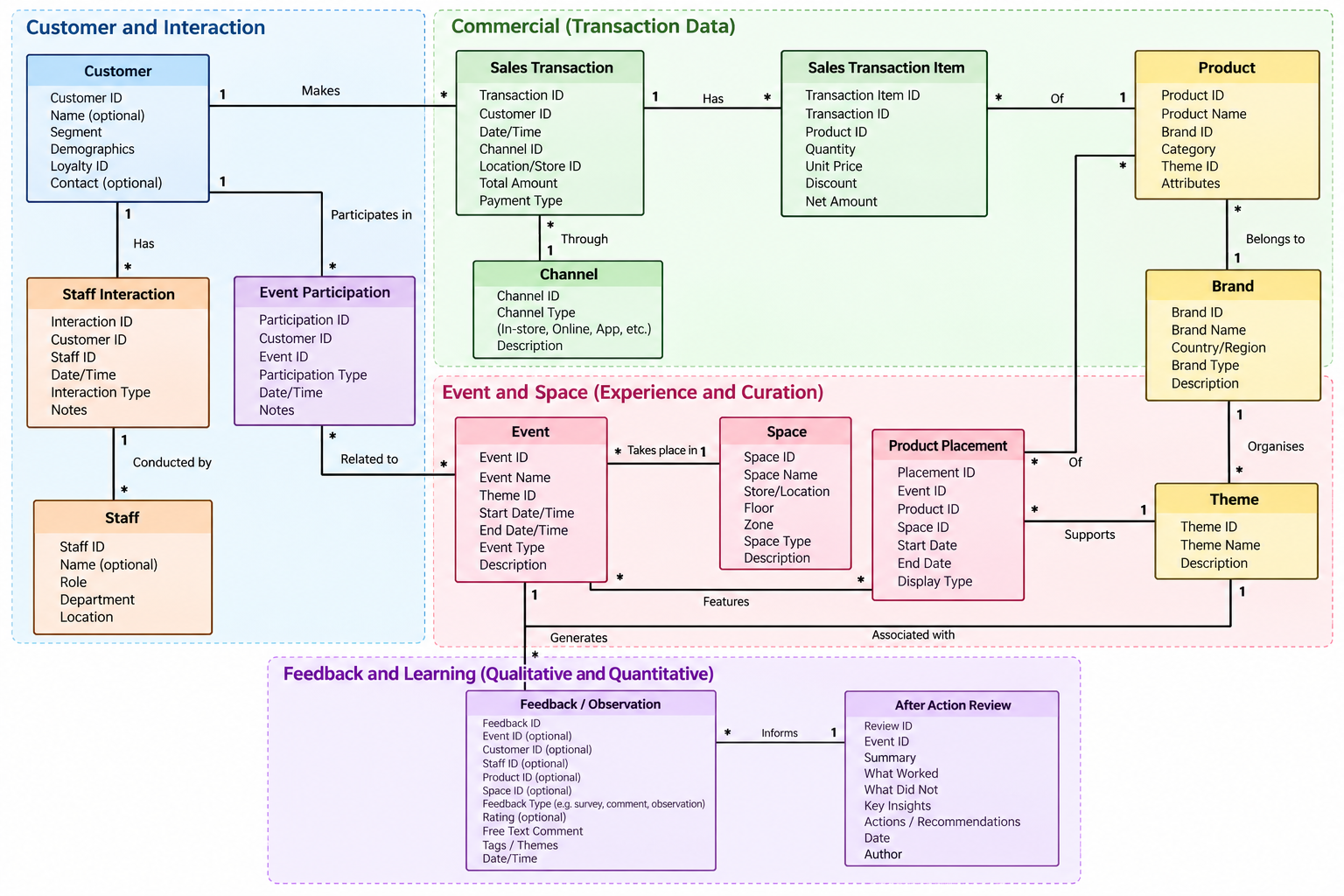
The proposed model does not require abandoning the traditional retail data model. Core entities such as customers, products, brands, transactions, staff and channels remain relevant.
What changes is the number of relationships that must be understood and the level of detail required to support decision-making. In a conventional model, the transaction is often the primary unit of analysis:
Customer → Transaction → Product → Brand
A more curated and experience-oriented model introduces additional context around that transaction:
Customer → Interaction → Event / Space / Staff → Product → Transaction
Events, product placements, themes and staff interactions therefore become relevant analytical objects in their own right. The retailer may need to understand not only what was sold, but also what the customer encountered before the sale and how different elements of the physical environment contributed to the outcome.
The model also introduces a stronger qualitative-information layer. Sales and behavioural data can indicate what happened, but they do not always explain why it happened.
Customer comments, staff observations, brand feedback and after-action reviews can provide additional context around events, temporary displays and other experiments. These observations may be structured through ratings or categories, but may also include unstructured notes and free-text feedback.
The resulting information cycle becomes:
Observe → Collect → Connect → Interpret → Review → Adjust
The objective is not to capture every customer interaction perfectly. It is to create enough organisational memory to determine which combinations of products, brands, spaces and experiences should be repeated, modified or discontinued.
The information architecture therefore supports a broader shift in business logic: from measuring isolated transactions towards understanding how value is created across the wider customer journey.
Business Logic
Traditional retail logic often asks: Which department generated the sale? This works when value is assumed to be created and captured primarily within a clearly defined department, brand or transaction.
A more curated and experience-oriented model, on the other hand, requires a broader question: Which combination of space, people, brands and interactions contributed to the customer outcome?
The sale may have been influenced by several factors at once: a temporary display, a staff recommendation, an event, a complementary product from another brand, or an earlier interaction in another channel. This changes the business logic from single-point attribution towards understanding contribution across the customer journey.
The purpose is not to assign perfect credit to every interaction. It is to make better decisions about which combinations of space, people, brands and experiences are actually creating value.
The Monetisation Problem
A more curated and experience-oriented department store may create more value without necessarily capturing more of it.
Creating more value does not automatically mean capturing more value.
The retailer may generate attention, discovery, physical validation, footfall, cultural relevance and stronger customer relationships. Brands may benefit from exposure, customer acquisition and association with the retailer's environment.
However, these benefits do not automatically appear as revenue for the department store.
A customer may discover a product during an event, receive advice from staff, try it physically and eventually purchase it directly from the brand online. The department store has contributed to the customer journey without necessarily capturing the resulting transaction.
This creates a monetisation problem.
Traditional department-store economics primarily capture value through mechanisms such as merchandise margins and concession income. A broader experience-oriented model may require additional mechanisms, including:
- activation and participation fees
- sponsorship
- retail media
- paid experiences
- memberships
- hospitality
- exclusive launches
- downstream attribution or commissions
Different activities may therefore require different value-capture models.
A fashion show may be justified through ticket revenue, sponsorship or subsequent sales. A temporary brand showcase may generate participation fees or customer acquisition value for the participating brand. Cross-brand curation may increase basket size. Hospitality may generate revenue directly while also increasing dwell time and strengthening the overall destination.
The objective is not necessarily to monetise every interaction individually.
Some activities may create indirect value through stronger customer retention, brand relationships or increased store relevance. The important question is whether the combined value generated by these activities can justify the additional space, labour, coordination and operational complexity required to deliver them.
The central commercial question therefore becomes:
Can the department store capture enough of the distributed value it creates to sustain the operating model?
If it cannot, experience risks becoming an additional cost layered onto an already mature retail business.
If it can, the department store begins to shift from relying primarily on transactions towards a broader portfolio of value-capture mechanisms.
Rethinking What Success Means
Growth May No Longer Be the Only Relevant Objective
Mature department stores operate within structural constraints that can make sustained expansion increasingly difficult. These may include saturated markets, constrained floor space, high fixed costs, mature demographics, digital substitution and limited opportunities for physical expansion.
This does not mean that growth is impossible. It means that growth may become more incremental, episodic or difficult to sustain, particularly when the underlying market is already mature.
Three Possible Strategic Outcomes
Growth
Experience, curation and improved customer journeys may generate incremental revenue, increase basket size or create new sources of commercial value. In this case, adaptation produces measurable expansion rather than merely protecting the existing business.
Defensive Adaptation
The same changes may instead slow deterioration in footfall, margins, relevance or customer relationships. This outcome can still be strategically valuable if the alternative is gradual erosion of the existing business.
Defensive adaptation should therefore not automatically be treated as failure. In a mature market, preserving a commercially viable position can itself represent a meaningful outcome.
Profitable Steady State
A third possibility is a relatively stable equilibrium in which revenue does not grow substantially but the business continues to generate operating profit and cash while retaining customer relevance, brand participation and sufficient capacity for reinvestment.
This shifts the question from whether the department store can continuously expand to whether it can remain economically useful and institutionally relevant over time. Stability becomes a legitimate strategic objective rather than simply an absence of growth.
The broader proposition is therefore:
For a mature department store, success may no longer mean sustained profit growth. It may mean sustaining profitable relevance.
Thought Experiment: Incumbents in Singapore
Takashimaya Singapore
This section is a thought experiment rather than a recommendation or prediction. Takashimaya Singapore operates within a mature, highly competitive retail market where physical space is constrained and customers can increasingly discover, compare and purchase products outside the department store. The question is therefore not whether Takashimaya should abandon the traditional department-store model, but how its existing strengths might be used differently as the customer journey changes.
Strengths
Takashimaya retains several advantages that are difficult to reproduce quickly. Its Orchard Road location, established retailer identity, premium positioning and long-standing presence give it a degree of trust and visibility that newer retailers must build from scratch. Its connection to Japan also provides a distinctive source of cultural and commercial capital.
That Japanese positioning could be particularly valuable because it gives Takashimaya a credible basis for introducing Japanese products, designers, craftspeople, food producers and emerging brands into Singapore. The opportunity is not simply to sell more Japanese products, but to provide context around them through stories, demonstrations, physical validation and cultural programming. Takashimaya can therefore potentially act as a gateway between Japanese producers and a Singapore market that those producers may struggle to access independently.
Publicly visible event spaces suggest that some of these capabilities already exist in fragments.[1] The more interesting question is whether similar principles could be applied more broadly across merchandising, curation and customer experience. That possibility is part of this thought experiment, rather than an assessment of Takashimaya's internal operating model.
Constraints
Takashimaya Singapore also operates at a substantially smaller scale than many of the international flagships discussed earlier. It cannot simply reproduce the breadth of Harrods or Galeries Lafayette by adding more brands, restaurants, exhibitions and experience spaces. Every experiment therefore carries a relatively high opportunity cost because the space used for one purpose cannot simultaneously be allocated elsewhere.
This makes selectivity important. Established premium and luxury brands may require stable environments, while incumbent customers cannot simply be displaced in pursuit of younger or more experimental segments. A more flexible model would therefore need to coexist with parts of the traditional department-store business that continue to generate value.
The range of categories also creates another difficulty. Fashion, beauty, food, home products and luxury goods do not share identical customer journeys, economics or brand relationships. The appropriate balance between experimentation, curation and conventional merchandising may therefore differ substantially across the store.
Opportunities
One opportunity lies in Takashimaya's relationship with Japan. Japanese craftsmanship, food, fashion, design and regional specialities can provide material for experiences that combine merchandise with provenance and cultural context. Temporary showcases and collaborations could also provide smaller Japanese brands with a lower-risk way to enter the Singapore market before committing to a permanent presence.
This could be extended to local and regional brands through curated adjacency. An established brand may attract the customer, while a complementary smaller brand benefits from being placed within the same customer context. The department store then creates value not simply by carrying both brands, but by deciding why they belong together.
Its Orchard Road location also places Takashimaya relatively close to the changing Somerset precinct and its youth-oriented cultural activity. The opportunity is not to turn Takashimaya into a youth mall, which would risk weakening its existing identity. A more interesting question is whether it can act as a commercial bridge between emerging cultural activity, younger audiences and established premium retail.
This could involve selectively introducing creators, local designers, emerging regional brands or cultural programming into spaces where they complement rather than replace the existing proposition. Such experiments would also allow Takashimaya to observe changing tastes without committing large amounts of permanent space immediately. Flexibility becomes a way of learning as much as a way of merchandising.
Threats
The structural threats remain significant. Direct-to-consumer channels allow brands to capture transactions independently, while price transparency makes it easier for customers to validate products physically in-store and purchase them elsewhere. Competing malls can also reproduce many experiential elements without needing to operate a department-store model.
Brand resistance may create another constraint. Luxury and premium brands often derive value from exclusivity, controlled presentation and carefully managed comparison, which can conflict with cross-brand curation. The department store therefore cannot assume that every brand will benefit from greater collaboration.
There is also the danger of creating experience without creating commercial value. Events, temporary installations and additional services consume space, labour and managerial attention even when they generate little measurable revenue. Without appropriate attribution and monetisation, an experience-oriented strategy could simply add complexity and cost to an already mature business.
Operational Prerequisites
The following requirements are implied by the hypothetical model. They are not assessments of Takashimaya's current internal capabilities.
A more adaptive model would require more than attractive events or better visual merchandising. Flexible space would need clear governance, cross-brand curation would require coordination between different commercial actors, and staff would need enough knowledge and discretion to support customers across categories rather than within narrow silos. Incentives would also need to avoid discouraging collaboration where the customer journey crosses organisational boundaries.
Experimentation would require stronger measurement as well. Events, product combinations and temporary showcases would need to be evaluated through both quantitative data and qualitative observations, including customer feedback, staff observations and after-action reviews. The objective would not be perfect attribution, but enough information to decide what should be repeated, modified, expanded or withdrawn.
The commercial logic would also need to evolve alongside the customer experience. If Takashimaya creates value through discovery, validation, brand exposure and cultural programming, the organisation must still determine how enough of that value is captured through merchandise sales, participation fees, sponsorship, hospitality, paid experiences or other mechanisms. Experience without value capture is not a sustainable operating model.
A Japanese Design Lens
Takashimaya's Japanese identity also provides several useful conceptual lenses for thinking about this transformation. Machizukuri asks what kind of place is being created, while omotenashi asks how people should experience that place. Kintsugi offers a useful metaphor for changing an established institution by recombining what remains valuable rather than discarding the existing model entirely.
These ideas should not be treated as evidence that the strategy would succeed. Their value is instead in framing the design problem: how can an established institution preserve its accumulated strengths while reorganising them around a changing customer journey? For Takashimaya, the most interesting future may therefore lie not in becoming something completely different, but in making its existing space, relationships and identity work together in a more deliberate way.
TANGS
TANGS begins from a different strategic position from Takashimaya. Its flagship sits within Tang Plaza, a freehold property owned by the company, giving it greater control over how the wider retail environment is configured and how value created by improvements to the property may ultimately be captured.[1] Industry observers have identified this control over space as one of the structural advantages separating TANGS and Takashimaya from weaker department-store operators in Singapore.
Strengths
TANGS combines a recognised Singapore identity with a prime Orchard Road location and direct control over its flagship property. Its public positioning already emphasises curated Singaporean and international brands across fashion, beauty, home, food and other categories, together with dining, rest areas, loyalty and digital shopping.
Property ownership gives TANGS another form of strategic leverage. Changes to tenant mix, shared areas, dining, wellness or experiential spaces can potentially contribute to the attractiveness of Tang Plaza as a whole rather than being evaluated only through immediate department-store sales. This allows the property itself to become part of the customer proposition.
Constraints
Owning the property does not remove the underlying challenges facing department stores. TANGS still competes with malls, specialist retailers, direct-to-consumer brands and e-commerce while carrying the operating complexity of a multi-category physical retailer. Public reporting indicates that its FY2024 profit remained positive but declined substantially from the previous year, suggesting that control of prime real estate does not make the retail economics effortless.[1]
Greater control can also create greater coordination requirements. If dining, wellness, brands, events and department-store merchandise are intended to reinforce one another, the organisation needs to decide where integration creates value and where independent operation remains preferable. Otherwise, Tang Plaza risks being experienced simply as several businesses occupying the same property.
Opportunities
TANGS could potentially use its control of Tang Plaza to make the property more flexible and deliberately curated over time. Temporary tenants, local brands, wellness concepts, food, events and retail categories could be combined around particular customer occasions rather than being treated solely as fixed allocations of space.
Public reporting on the recent redevelopment points towards a broader lifestyle mix. The reopened Tang Plaza basement contains more than 50 brands, with most focused on food and dining and the remainder on wellness, while its VivoCity store has been positioned differently for younger families.[1]
The thought experiment therefore becomes less about transforming the department store alone and more about treating the wider property as a programmable retail ecosystem. TANGS' leverage lies in being able to curate the place, the tenants and the department-store proposition together.
Threats
The same strategy is increasingly available to shopping malls. Dining, wellness, pop-ups and experiential concepts are now normal components of major Singapore retail developments, meaning that property control alone does not guarantee differentiation. TANGS still needs a reason for customers to value the TANGS layer rather than simply the individual tenants inside Tang Plaza.
There is also a risk that increasing flexibility produces complexity without corresponding value capture. Rotating tenants, events and cross-category programming require coordination, measurement and management attention. The advantage exists only if TANGS can use its control of the property more intelligently than competitors who control similar spaces.
Operational Prerequisites
For TANGS, greater control over Tang Plaza would only become strategically useful if the organisation can coordinate the property as a whole rather than optimise each component independently. This would require flexible space governance, stronger coordination across tenants and department-store functions, and clear rules for when temporary concepts, events or cross-category programmes should displace existing uses of space.
Information management would also need to extend beyond department-store transactions. TANGS would need to understand how different tenants, events, dining concepts and shared spaces contribute to footfall, repeat visits and spending across the wider property. The relevant question becomes not only which unit generated revenue, but which combinations of tenants and experiences increased the overall value of Tang Plaza.
Commercial incentives would therefore need to support collaboration rather than purely individual tenant performance. If an event in one part of the property increases traffic or spending elsewhere, the organisation needs some way to recognise that distributed value. Otherwise, potentially useful collaborations may be difficult to justify using conventional sales-per-square-metre measures alone.
Finally, flexibility requires discipline. Temporary tenants, events and new concepts should be treated as experiments with clear objectives, measurable outcomes and after-action reviews. The ability to stop or modify unsuccessful concepts is as important as the ability to launch them.
Strategic Question
The central question for TANGS is therefore:
Can control of Tang Plaza allow TANGS to evolve from curating merchandise towards curating an integrated place, while capturing enough of the resulting value to justify the additional complexity?
OG
OG represents a very different department-store equilibrium. Following the closure of Orchard Point in 2022, it now operates two stores at Albert Complex and People's Park, away from the premium Orchard Road environment occupied by TANGS and Takashimaya. Industry observers have consequently described OG as a niche survivor rather than a scale-driven department-store operator.
Strengths
OG has a relatively clear proposition centred on affordability, family shopping and a broad everyday assortment. Its own stated vision is to be a family-friendly store with affordable prices, covering categories such as apparel, footwear, bags, homewares, travel goods, supplements, children's products and toys.[2]
Its remaining locations may also provide a different cost structure from premium Orchard Road retail. Both Albert Complex and People's Park sit in established city districts with footfall from older residents, value-conscious consumers and tourists.
Constraints
OG lacks the destination positioning and premium brand ecosystem available to Takashimaya and TANGS. Its withdrawal from Orchard Road also means less exposure to the affluent local and tourist traffic concentrated along Singapore's principal luxury retail corridor.
There is also less public financial information available because OG operates as an exempt private company. This makes it difficult to determine externally whether its narrower model produces strong profitability or simply allows the business to continue operating with a lower cost base.
Opportunities
OG does not necessarily need to imitate the experience-oriented strategies of international flagships. Customer-centred design for its market may instead mean straightforward navigation, appropriate assortment, accessible prices, dependable service and greater convenience for customers who know what they need.
There may also be room to deepen this proposition through practical services rather than expensive spectacle. Delivery, alterations, product assistance, simple digital integration or services relevant to older and family customers could potentially create more value than large-scale experiential installations.
Its narrower positioning can therefore become an advantage if OG understands its customers better than retailers attempting to appeal to everyone. Instead of competing on cultural prestige or sheer assortment, it can compete on usefulness.
Threats
OG's value proposition faces intense competition from e-commerce platforms, discount chains and specialist retailers capable of competing aggressively on both price and assortment. If customers primarily value low prices and convenience, online commerce can reproduce much of the traditional department-store proposition without the costs associated with large physical premises.
Its existing customer profile also creates a longer-term succession question. A loyal older customer base may sustain the business today, but the retailer eventually needs either younger replacement customers or sufficient economic value from its existing niche to remain viable as demographics change.
Operational Prerequisites
OG would require a much lighter operating model because its potential advantage lies in focus rather than complexity. The organisation would need a clear understanding of which customer segments it intends to serve, which categories matter most to those customers and which services genuinely improve convenience or usefulness.
Customer information becomes important here as well, but the questions are simpler. OG may need to understand repeat purchasing, category preferences, service needs and how its customer base is changing over time. Qualitative feedback from frontline staff may be particularly useful because they are likely to observe changes in customer needs that transactional data alone cannot explain.
Operational improvements should also remain proportionate to the business model. Delivery, alterations, assisted shopping or simple digital integration may create more value than expensive experiential spaces if they solve practical customer problems. The objective would be to add complexity only where customers clearly value it.
OG's main prerequisite is therefore strategic discipline. It would need to resist copying premium competitors simply because those formats appear more modern, while still adapting where its existing proposition becomes less relevant. Customer-centred design in this context means knowing what not to add as much as knowing what to change.
Strategic Question
OG therefore raises a different question from either Takashimaya or TANGS: Can a department store remain sustainably relevant by deliberately narrowing its ambition, serving a defensible customer niche and avoiding the cost of competing as a premium experience destination?
Conclusion: Perhaps None of This Is New
After all of this, perhaps none of the underlying ideas are especially new. Much of the proposed transformation is simply user-centred design applied beyond the interface and into the operating model of the department store. The difficult part is that organisations are rarely structured according to how customers actually experience them.
The customer does not care which concession owns a product, which department receives the revenue, which team controls the space or how internal reporting lines are organised. They care about finding something relevant, understanding it, experiencing it, deciding whether it fits their needs and acquiring it on acceptable terms. Internal boundaries only become visible when they interfere with that journey.
This is where the department store may still have a role. Its value may no longer come primarily from placing the greatest possible assortment under one roof, but from helping customers navigate products, brands, services and experiences that are increasingly fragmented across physical and digital channels. Curation, physical validation, service and relationships can restore some coherence to that journey.
However, there is no reason to assume that every department store should respond in the same way. OG is useful precisely because it prevents the argument from becoming too deterministic: a retailer may remain relevant through focus, affordability and usefulness rather than becoming more experiential, premium or operationally complex. Customer-centred design does not imply a single format; it implies adapting the institution around the customers it can credibly serve.
The same applies to Takashimaya and TANGS. Their different assets, constraints and sources of strategic leverage should produce different responses even if they begin from the same underlying principle. The objective is not to imitate Harrods, Galeries Lafayette, Decathlon or any other comparator, but to understand which mechanisms are transferable and which are not.
Creating a better customer experience is also insufficient if the retailer cannot capture enough of the value it creates. More discovery, validation, footfall or cultural relevance may benefit customers and brands without necessarily producing corresponding revenue for the department store. The operating model therefore has to connect customer value with information, measurement and sustainable mechanisms of value capture.
The department store may therefore not require a revolutionary new concept. It may require its physical space, people, information systems and commercial logic to become more closely organised around how customers actually create and experience value. The challenge is not merely to redesign the store. It is to redesign the institution behind the store.
Footnotes & References
- Koh, W. T. (2025). ‘Why Tangs and Takashimaya thrive while other Singapore department stores struggle’. Channel NewsAsia, 11 December 2025. CNA article
- OG Private Limited (n.d.). ‘About Us’. OG Singapore. Accessed 28 October 2026. OG About Us
- Decathlon Singapore (n.d.). ‘Decathlon Sports Shops Near You’. Describes its Experience Store format, product testing, sports events, personalisation and Click & Collect model. Accessed 28 October 2026. Decathlon Singapore stores
- Decathlon Singapore (n.d.). ‘Decathlon Buy Back: Old Sports Products Meet New Adventures’. Accessed 28 October 2026. Decathlon Buy Back
- Decathlon Singapore (n.d.). ‘Bike Maintenance & Repairs’. Accessed 28 October 2026. Decathlon bike maintenance and repairs
- Sephora Singapore (n.d.). ‘Beauty Services’. Includes foundation matching, personalised recommendations, makeovers and other Beauty Advisor-led services. Accessed 28 October 2026. Sephora Singapore Beauty Services
- Galeries Lafayette Paris Haussmann (n.d.). ‘Original Fashion Shows’. Galeries Lafayette Paris Haussmann. Accessed 28 October 2026. Galeries Lafayette Fashion Shows
- Galeries Lafayette Paris Haussmann (2026). ‘Galeries Lafayette Paris Haussmann hosts exclusive Céline Dion pop-up’. Galeries Lafayette Paris Haussmann. Céline Dion Pop-Up
- Selfridges (n.d.). ‘Reselfridges’. Describes Selfridges’ pre-owned, resale, recycling, repair and refill services. Accessed 28 October 2026. Reselfridges
- Selfridges (n.d.). ‘Reselfridges Resell’. Describes the resale process and payment through Selfridges store credit. Accessed 28 October 2026. Reselfridges Resell
- Harrods (n.d.). ‘The Beauty Halls’. Describes Harrods’ Beauty Concierge, treatments, events, masterclasses and multi-brand beauty environment. Accessed 28 October 2026. Harrods Beauty Halls
- Harrods (n.d.). ‘H beauty’. Describes Harrods’ standalone beauty format combining consultations, treatments, events, pop-ups, product experimentation and hospitality. Accessed 28 October 2026. Harrods H beauty